Showing posts with label Arms and Armor. Show all posts

Thursday, July 24, 2008

Menuki (what?)

A fellow student and I recently discussed the placement of menuki as part of a sword's koshirae. The question at hand was whether menuki were actually placed to align with the palm of the hands on the tsuka. None of the iaito in our dojo had the menuki placed thus, but that constituted only anecdotal evidence. Ross' book 'In Search of Mishima's Sword' claims that real swordsman placed the menuki to support grip, but he doesn't cite a source, making it hard to establish the veracity of his claim. So I went looking elsewhere, and came across this reference, which states that:


"From a pure functionalist point of view, menuki was basically born out of rather pragmatic demand to serve primarily as “mekugi osae” or the cover (or lid) over mekugi pin. Examinations of old Kara-tachi and Kazari-ken koshirae made in Nara through early Heian periods, such as the ones in Shosoin Museum and Tokyo National Museum, tend to confirm this functional origin of menuki among the earliest styles koshirae. (See Ogasawara, 1994 for photos.)

However, soon its secondary function to serve as a pair of ornaments began to be emphasized equally (Suzuki, 1995). Additionally, many other “latent functions (i.e., not originally intended or obvious but still important eu-functions)” were discovered (e.g., tactile indicators to tell the correct orientation of the edge or correct “tenouchi,” palm swells, status/rank symbols, religious charm, etc.). Then over the course of the evolution of Nihon-to koshirae, those secondary and latent functions of menuki seem to have taken over its “manifest function (i.e., originally intended and well recognized purpose)" completely."

This offers an explanation of sorts.  

Wednesday, June 20, 2007

Katori Shinto Ryu -- you must read this!

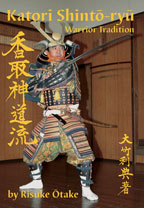
Koryu.com, one of my listed links, has just produced a new book that any serious student of Japanese martial arts should get their hands on. It is dual language, with many black and white photos throughout. While is concentrates on omote techniques, it is nevertheless a valuable resource if you're interested in gaining an insight into the thoughts and techniques of one of the greatest living swordsmen.
clipped from www.koryu.com

Katori Shinto-ryu
New from Koryu Books:
Otake Risuke's Katori Shinto-ryu: Warrior Tradition

blog it

Saturday, December 16, 2006

Sword Furnishings

It's been a long time in preparation, but finally I have another installment of images, this time of koshirae, from the Japanese Arms and Armour exhibition I attended some months ago. This chapter is longer, with more images, which are (of course) again available if anyone wants a copy--not that anyone asked last time.

Koshirae (the sword mountings with fittings that form a principal artistic part of the Japanese sword) are an art in and of themselves. They form an important part of the making of the sword, and often reflect particular virtues and interests or other symbolic meaning. To keep this entry short, I'll not delve into the thematic content of each piece or the history of koshirae in general. If you want more information on Japanese sword furniture, see Koshirae: Nihon Token Gaiso - The Mountings of Japanese Swords by C. U. Guido Schiller.

The following notes have been borrowed directly from the display text that accompanied the exhibition (except where text is in yellow). All credit for the technical notes goes to the Benalla Art Gallery and the Australian Society for the Preservation of Japanese Art Swords.

1. Tsuba (sword hand guard)

PERIOD: late Edo period (19th century)
MEI: Suruga Takaoki Inshû jû (d1856)
SUBJECT: Goose in long grass
MATERIAL: Iron

Takaoki (his personal name is Hayata Chujirô) was the son of Suruga Takashige and was ninth hereditary master of the Suruga of Inaba.


PERIOD: late Edo period (19th century)
MEI: unsigned - attributed to Ichijôsai Hirotoshi
SUBJECT: Battle of Mount Ishibashi
MATERIAL: shakudo, subject in raised iroe takazogan in shibuichi

This tsuba is unsigned but a similar signed work bearing the name of this artist is in the collection of the Museum of Decorative Arts, Copenhagen. The identification has been endorsed by the Japan Art Sword Preservation Museum.


PERIOD: Mid Edo period (ca 1700)
MEI: Signed on reverse Naoyuki (of the Hamano school)
SUBJECT: Kanzan and Jittoku with Tiger
MATERIAL: Iron

‘Kanzan and Jittoku’, a temple cleaner and poet-monk, are a popular Zen subject of Chinese origin.

2. Kozuka (a small knife with a decorative metal handle inserted in a slot in the scabbard of a sword)


PERIOD: mid Edo period (ca 1700)
MEI: Hamano Naoyuki
SUBJECT: tiger
MATERIAL: shibuichi

I am particularly taken by this kozuka. The intensity of the tiger's face is striking; in particular, the tiger's eyes are filled with a human intelligence that I find intriguing.


PERIOD: mid Edo period (ca 1740)
MEI: Tsu Jimpo
SUBJECT: A samurai mounted on a tiger chasing an ogre
MATERIAL: shakudo nanako with coloured metal overlay

Tsu Jimpo (1720-1761) belonged to the Awa branch of the Gotô school. He was a student of Naomura Masamichi and of Gotô Tsujô, the 9th master of the main Gotô line. This piece shows the official courtly Gotô style.

3. Set of Tsuba, Fuchi and Kashira

PERIOD: late Edo period (19th century)
MEI: Ishiguro Ichiju with kao
SUBJECT: crests
MATERIAL: shakudo nanako with iroe takazogan

The Ishiguro School was founded by Ishiguro Masatsune I (1760-1828). Ichiju was either a son or a pupil of Masatsune’s son Koretsune. While the Ishiguro School is characterised by its use of vibrant colours, the understated design of this set expresses the formal and subtle taste of the higher-ranking samurai.

4. Kogai (a small skewer-like utility implement inserted in the scabbard)

PERIOD: Late Momoyama/early Edo period (ca 1600)
MEI: unsigned – attributed to Ko Gotô
SUBJECT: Dragon entwined around Buddhist sword
MATERIAL: shakudo

5. Menuki (pair of carved metal ornaments under hilt binding)

PERIOD: Edo period (ca 1780)
MEI: unsigned – attributed to Mito Kuni
SUBJECT: Temple guardians (Nio)
MATERIAL: shibuichi


---------------------------------
That's all for now. I'm very pleased with the photos. I hope you're enjoying them as well, and the small amount of technical information I have on them. Keep an eye out for the final part of this exhibition, focussed on the blades and their mountings.

Saturday, November 11, 2006

Japanese Armour

Recently, I attended a 'Japanese Arms and Armour' exhibition at Benalla, in country Victoria; it was a long drive and the exhibition was limited, but the visit was fascinating and well worth the effort. This is the first of several posts showing the exhibition's contents. All photos were taken using a Nikon Coolpix 5400 mounted on a tripod. The gallery staff were obliging enough to let me take the photos, provided I didn't use a flash. Luckily, the lighting was great. I was also fortunate enough to attend on a week day, obviating the need to contend with crowds.

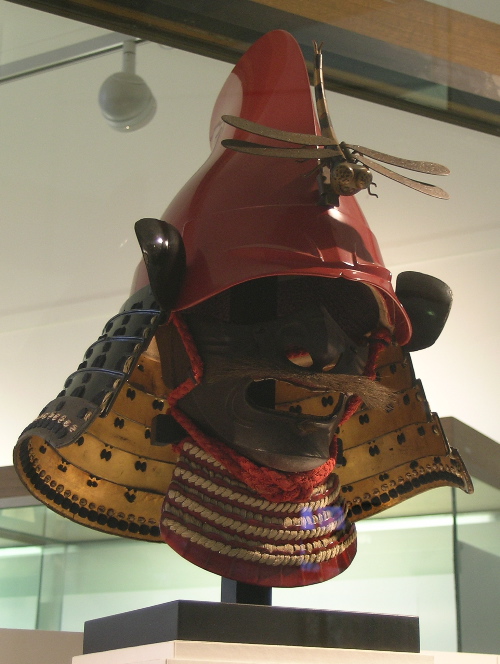
The photo above shows an iron eboshi kabuto (helmet) coated in red lacquer and rising from a four-plate iron hachi (bowl). It dates from the mid-Edo period (1750-1800), but is fashioned in the shape of the Heian period (782-1167) eboshi, worn by courtiers and high-ranking samurai, reminding us that fashion truly is cyclical.

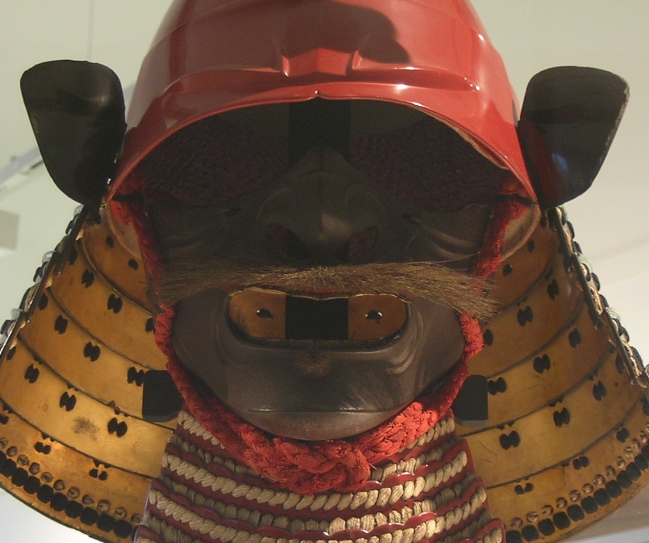
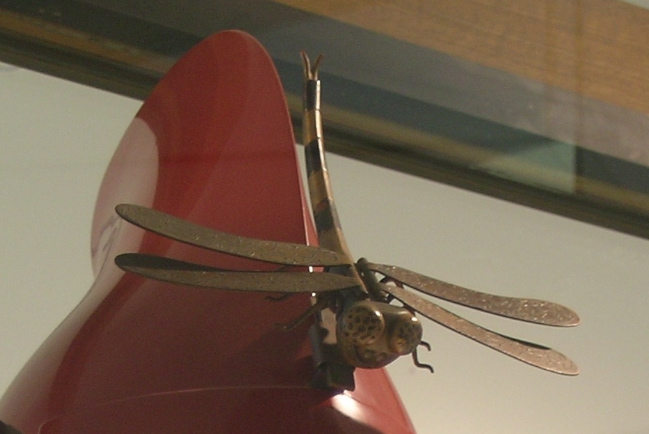
The menpo (face mask) dates from the same period as the kabuto. It is shaped with an open mouth and a horsehair moustache. While it looks like a russet iron surface, the maedate is actually iron covered in lacquer, just like the helmet. The maedate is in the form of a katsumushi (dragonfly). The body of the dragonfly is constructed of brass, while the wings are hinged and detailed with black lacquer. All in all, the piece was well preserved and striking to behold: the katsumushi is particularly engrossing, with exquisite detail.

The katsumushi or tonbo (the name more familiar to modern readers) is a common motif on Japanese arms, armour and clothing. The term means 'invincible insect', and for the bushi it represented courage and perseverance in battle. It is also referred to as the kachimushi, or 'victory insect'. The power of the motif is uniquely reflected in Tonbogiri, the Dragonfly Cutter. Tonbogiri was one of three legendary spears made by the swordsmith Masazane (active during the Muromachi period), and was so named because a dragonfly (perhaps apocryphally) landed on its blade and was instantly cut in two.

Unfortunately, this was the only piece of armour at the exhibition, but a number of swords and associated fittings were also on display. Plenty of photos and information will follow, so I hope you like this sort of thing. Larger versions of the photos are available upon request, provided they are not used for commercial purposes; they make good wallpapers.

I would like to acknowledge the generosity of the members of the Australian Society for the Preservation of Japanese Art Swords, who made their collection available for public viewing. I'd also like to thank the Benalla Gallery, which did a wonderful job of putting these beautiful objects on display.