Showing posts with label History. Show all posts

Monday, March 09, 2009

(Like) I'm in California

Wow. Nine months since my last post. I guess life gets in the road. Or maybe I was just waiting for something to write about, and now I've found it. I'm in California on business, and California is the place of impressions (both banal and profound), so I'm going to write about them.


That's right. California. The place where the word 'like' is so frustratingly common that it probably needs to be made an article in the English language, where being blonde is de rigeur and where the sun really does seem to shine more than it does in Queensland. I landed in LA, like, and immediately proceeded through the bus-terminal-like (that was a real 'like', as in a proper use of the word to indicate a simile) airport and to a waiting hire car. And then it was straight out of LA--via the traffic on highway 10340772-I (whatever that means)--and on to Santa Barbara. Along the way I had a strange sense of disconnection. The signs I passed by made me feel very much embedded in a Hollywood cop show, sitcom or song; Sunset Strip, Venice Beach, Santa Monica Boulevard, Beverly Hills, Malibu, Orange County flowed past me until I wasn't sure whether the experience was real or whether I'd been transported by Wonkavision into some TV programmer's idea of Heaven.

But then I reached Santa Barbara, and all was made good. What a beautiful town, even if it was populated by said blondes with brightly coloured shopping bags bearing all the right labels. The Spanish architectural influence shines through in a way that isn't tacky at all, not like when you see it on the Gold Coast. And the food that I did get to try--vegetarian mexican with fried black beans, tofu and (admittedly tasteless) cheese--was actually enjoyable, if not necessarily as richly flavoured as I might expect in Melbourne. I spent a day realising that underneath the cliche that first confronts you when you arrive in America were warm people who were proud of who they were and just wanted to help. It was easy to spend a day in Santa Barbara. The Santa Barbara Museum of Art was exceptional, with a brilliant collection of Asian artifacts (pictured will be posted up as soon as I can), the courthouse was beautiful inside and out and free, with a view from the tower that would cost money most places, and the town itself was about as picturesque as one could imagine, recalling the adobe walls and laced ironwork of an era long past. An archeological site (that's right, in the most hip of hip places), El Presidio de Santa Barbara, matched any historical site in Europe as far as transporting one back in time goes. Yes, not as grand as the abbey ruins in Canterbury or as culturally alien as tombs from pre-historic Japan, but transporting nonetheless, and somehow more immediate. You could feel Lt. Jose Francisco de Ortega pacing the Presidio after even 225 years, wondering how to protect the Spanish territories from the English and the French.

But such a day had to end, and that night took me to Lompoc, a town atmospheric for a very different reason. At Lompoc, and in the surrounding Santa Ynez valley towns, I saw less class and more kitsch. I also finally articulated my problem with tipping. And, somewhat unexpectedly, I once more touched on the wonders of America. But that's for the next episode, where I 'll tell you how I experienced Obama, Denmark, Hiroshige, olives and coffee all without leaving the States.

Sunday, March 23, 2008

Places of note

I've come across a great blog for those of you interested in reading about ancient Japan written by 'Nagaeyari, an amateur historian with an interest in early Japanese history'. Ancient Japan is full of snippets of information, as well as a serial introduction to Japanes history from the (almost) mythological past through to more recent events. The Samurai Wiki is another great resource. This wiki has a number of interesting links, including to the Samurai Archives History Journal, a soon-to-be-published journal on that topic we all know and love. Guidelines for authors are included for all those professional and amateur history buffs out there. Frog in a Well/Japan is another informative blog, and it includes plenty of links to sites that delve into all things oriental. Plenty of good reading. Subscribe using RSS and you'll always have something fascinating in your e-mail tray. I've included links to these sites in the Links section, for convenience.

Saturday, December 16, 2006

Sword Furnishings

It's been a long time in preparation, but finally I have another installment of images, this time of koshirae, from the Japanese Arms and Armour exhibition I attended some months ago. This chapter is longer, with more images, which are (of course) again available if anyone wants a copy--not that anyone asked last time.

Koshirae (the sword mountings with fittings that form a principal artistic part of the Japanese sword) are an art in and of themselves. They form an important part of the making of the sword, and often reflect particular virtues and interests or other symbolic meaning. To keep this entry short, I'll not delve into the thematic content of each piece or the history of koshirae in general. If you want more information on Japanese sword furniture, see Koshirae: Nihon Token Gaiso - The Mountings of Japanese Swords by C. U. Guido Schiller.

The following notes have been borrowed directly from the display text that accompanied the exhibition (except where text is in yellow). All credit for the technical notes goes to the Benalla Art Gallery and the Australian Society for the Preservation of Japanese Art Swords.

1. Tsuba (sword hand guard)

PERIOD: late Edo period (19th century)
MEI: Suruga Takaoki Inshû jû (d1856)
SUBJECT: Goose in long grass
MATERIAL: Iron

Takaoki (his personal name is Hayata Chujirô) was the son of Suruga Takashige and was ninth hereditary master of the Suruga of Inaba.


PERIOD: late Edo period (19th century)
MEI: unsigned - attributed to Ichijôsai Hirotoshi
SUBJECT: Battle of Mount Ishibashi
MATERIAL: shakudo, subject in raised iroe takazogan in shibuichi

This tsuba is unsigned but a similar signed work bearing the name of this artist is in the collection of the Museum of Decorative Arts, Copenhagen. The identification has been endorsed by the Japan Art Sword Preservation Museum.


PERIOD: Mid Edo period (ca 1700)
MEI: Signed on reverse Naoyuki (of the Hamano school)
SUBJECT: Kanzan and Jittoku with Tiger
MATERIAL: Iron

‘Kanzan and Jittoku’, a temple cleaner and poet-monk, are a popular Zen subject of Chinese origin.

2. Kozuka (a small knife with a decorative metal handle inserted in a slot in the scabbard of a sword)


PERIOD: mid Edo period (ca 1700)
MEI: Hamano Naoyuki
SUBJECT: tiger
MATERIAL: shibuichi

I am particularly taken by this kozuka. The intensity of the tiger's face is striking; in particular, the tiger's eyes are filled with a human intelligence that I find intriguing.


PERIOD: mid Edo period (ca 1740)
MEI: Tsu Jimpo
SUBJECT: A samurai mounted on a tiger chasing an ogre
MATERIAL: shakudo nanako with coloured metal overlay

Tsu Jimpo (1720-1761) belonged to the Awa branch of the Gotô school. He was a student of Naomura Masamichi and of Gotô Tsujô, the 9th master of the main Gotô line. This piece shows the official courtly Gotô style.

3. Set of Tsuba, Fuchi and Kashira

PERIOD: late Edo period (19th century)
MEI: Ishiguro Ichiju with kao
SUBJECT: crests
MATERIAL: shakudo nanako with iroe takazogan

The Ishiguro School was founded by Ishiguro Masatsune I (1760-1828). Ichiju was either a son or a pupil of Masatsune’s son Koretsune. While the Ishiguro School is characterised by its use of vibrant colours, the understated design of this set expresses the formal and subtle taste of the higher-ranking samurai.

4. Kogai (a small skewer-like utility implement inserted in the scabbard)

PERIOD: Late Momoyama/early Edo period (ca 1600)
MEI: unsigned – attributed to Ko Gotô
SUBJECT: Dragon entwined around Buddhist sword
MATERIAL: shakudo

5. Menuki (pair of carved metal ornaments under hilt binding)

PERIOD: Edo period (ca 1780)
MEI: unsigned – attributed to Mito Kuni
SUBJECT: Temple guardians (Nio)
MATERIAL: shibuichi


---------------------------------
That's all for now. I'm very pleased with the photos. I hope you're enjoying them as well, and the small amount of technical information I have on them. Keep an eye out for the final part of this exhibition, focussed on the blades and their mountings.

Saturday, November 11, 2006

Japanese Armour

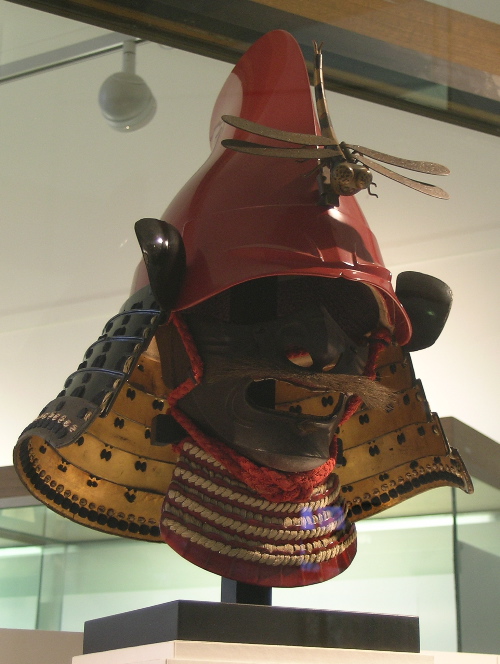
Recently, I attended a 'Japanese Arms and Armour' exhibition at Benalla, in country Victoria; it was a long drive and the exhibition was limited, but the visit was fascinating and well worth the effort. This is the first of several posts showing the exhibition's contents. All photos were taken using a Nikon Coolpix 5400 mounted on a tripod. The gallery staff were obliging enough to let me take the photos, provided I didn't use a flash. Luckily, the lighting was great. I was also fortunate enough to attend on a week day, obviating the need to contend with crowds.

The photo above shows an iron eboshi kabuto (helmet) coated in red lacquer and rising from a four-plate iron hachi (bowl). It dates from the mid-Edo period (1750-1800), but is fashioned in the shape of the Heian period (782-1167) eboshi, worn by courtiers and high-ranking samurai, reminding us that fashion truly is cyclical.

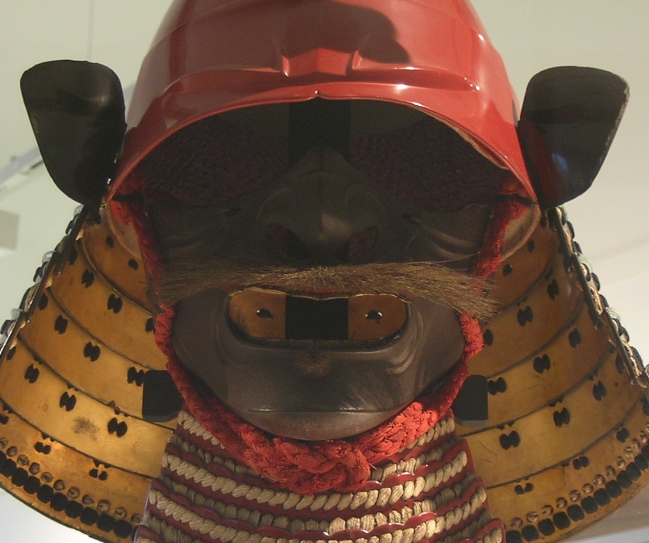
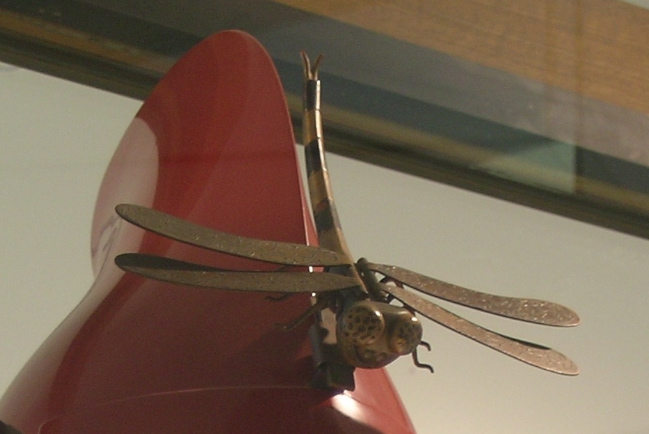
The menpo (face mask) dates from the same period as the kabuto. It is shaped with an open mouth and a horsehair moustache. While it looks like a russet iron surface, the maedate is actually iron covered in lacquer, just like the helmet. The maedate is in the form of a katsumushi (dragonfly). The body of the dragonfly is constructed of brass, while the wings are hinged and detailed with black lacquer. All in all, the piece was well preserved and striking to behold: the katsumushi is particularly engrossing, with exquisite detail.

The katsumushi or tonbo (the name more familiar to modern readers) is a common motif on Japanese arms, armour and clothing. The term means 'invincible insect', and for the bushi it represented courage and perseverance in battle. It is also referred to as the kachimushi, or 'victory insect'. The power of the motif is uniquely reflected in Tonbogiri, the Dragonfly Cutter. Tonbogiri was one of three legendary spears made by the swordsmith Masazane (active during the Muromachi period), and was so named because a dragonfly (perhaps apocryphally) landed on its blade and was instantly cut in two.

Unfortunately, this was the only piece of armour at the exhibition, but a number of swords and associated fittings were also on display. Plenty of photos and information will follow, so I hope you like this sort of thing. Larger versions of the photos are available upon request, provided they are not used for commercial purposes; they make good wallpapers.

I would like to acknowledge the generosity of the members of the Australian Society for the Preservation of Japanese Art Swords, who made their collection available for public viewing. I'd also like to thank the Benalla Gallery, which did a wonderful job of putting these beautiful objects on display.

Wednesday, November 08, 2006

Hizakurige

My son and I went for a bike ride today, and I took the opportunity to dash into the local second-hand book store. I purchased several books, pleased with my finds, but I glimpsed something special on the way out: a Tuttle first edition of Hizakurige (膝 栗毛), Ikku Jippensha's (十返舎一九, 1765-1831) classic comedy. It is, ostensibly, a novel about the adventures of two misfits, Yajirobei (彌次郎兵衛) and Kitahachi (喜多八), as they travel on the road from Edo to Kyoto. But it is really a travelogue, composed by Jippensha between 1802 and 1809 as a serial. Thomas Satchell first translated Hizakurige in 1929 as Shank's Mare, and that genuine first edition is apparently quite valuable. As far as I can tell, the 1960 Tuttle edition I now hold, essentially a reprint of Satchell's original translation, is itself quite a find; Amazon reports only three used copies for sale.

I was initially drawn to the book purely by its cover: a wood block print by one M. Kuwata (a Japanese woodblock artist from the 1950s). I was already tempted by the promise of something simultaneously new and antiquarian, but I was sold (or, rather, the book was) when I flipped open the cover to find that this edition was accompanied by the little-known fifth version of Hiroshige's The Fifty-three Stages of the Tokaido. The fifty-five full-colour prints (fifty-three stages plus the prologue and epilogue prints) are sprinkled throughout the book. I stood in the bookshop momentarily stunned. In my hand I held two wonders in one volume: a tale of old Japan I'd not read, and a set of nostalgic woodblock prints, admittedly small, by Hiroshige.

As to Jippensha, he was the son of a minor official and worked in administrative posts himself, at least until he turned to literature to earn his livelihood. Apparently, he had little patience for hypocrisy or pomposity, hating priests and contemptuous of swaggering samurai. One wonders how much of the humour in Hizakurige disguises a more sober social commentary. Perhaps ironically, he is buried in the grounds of the Zenryuji, at Asakusa, Tokyo; how it must grate on his spirit. Three years after his death relatives and friends raised a monument to him, with an inscription and a poem. The poem reads:

My allotted span of life has passed;
Oh, give me peace and rest at last!

The companion inscription is particularly apt, and I quote one part:

[T]hings of which people never tire are a bright moonlight night and dinner, to which may be added a book and sake.

Well, Mr Jippensha, I don't have any sake, but I have your book, and methinks it will suffice. Kampai!