Showing posts with label Martial Arts. Show all posts

Sunday, February 03, 2008

Ichigo, Ichie (一期一会)

The term ichigo, ichie is inscribed on the side of my bokuto, just below the tsuba. I see it frequently, about half the time that I draw my bokuto from its saya, but I don't always notice it. Recently listening to an interview with Dave Lowry, the author of (amongst other things) 'Autumn Lightning: the Education of an American Samurai', I was reminded of the ichigo ichie concept and why I'd had it put in such an overt place. 

Ichigo, ichie is literally 'one time, one meeting', but it might also be interpreted as 'one moment, one life' or 'one chance in  lifetime'. [1] In the interview, Lowry was using the concept specifically to emphasise the distinction between western fencing and Japanese fencing: in particular, that western fencing tends towards a battle of attrition, with fencers succumbing to prolonged blood loss from many deep cuts and lacerations, while Japanese fencing tends towards short and brutal. 

But Ichigo ichie is clearly of broader relevance to martial artists. For example, it shapes our attitude to the practice of koryu. When we practice kata, we must respond to the moment that is and not to the moment that was or that might be -- in other words, we need to avoid the tendency to intellectualise during the event, to pause and analyse, or to deconstruct as if deconstruction makes sense within a kata that is sensible only as a whole. Furthermore, each kata in Tatsumi ryu [2] ends with a moment of zanshin, a state of relaxed alertness. In zanshin, we are open to the moment and what it holds, not revelling in our victory or thinking of the battle's end. Again, this is a perfect embodiment of the idea of ichigo ichie.  

Ichigo ichie extends to guiding our everyday attitude. We experience each moment only once, and so we should live within it, notice it, respond to it as if it is the only moment we will know. The message is simple and yet, in our hectic lives, we seem to regret and hope, when we might just be. I'm as prone to this as the rest, and so I had the characters engraved on my bokuto. Now all I have to do is notice them when I see them. 

[1] See Dave Lowry's article here for further discussion. 
[2] Keeley, L 1999. 'The Tojutsu of Tatsumi Ryu, Murphy's Law, and the K.I.S.S. Principle', Sword and Spirit: Classical Warrior Traditions of Japan v2, Berkeley Heights, NJ:Koryu Books 

Friday, June 22, 2007

A Tatsumi Ryu Snapshot

I study Tatsumi ryu (立身流 Tatsumi-ryū Hyōhō): a Koryu, or classical tradition. It originates in the Sengoku Jidai period in Japan, and was founded by Tatsumi Sankyo, who was born in what is now Ehime Pefecture, on Shikoku Island. I won't delve into the history or essential principles of the system; after all, it isn't my place as a student to be telling the world about Tatsumi ryu. For that, I suggest visiting the Wikipedia entry here or Liam Keeley Sensei's home page here. But I thought people might be interested in seeing photographs of the art. Some are available at the links above, but I have a couple of interest that aren't available (or, at least, not in the resolution I've provided them). The photographs were taken by Neill Smith in 2006.


Without giving too much away, it is worth noting that this particular ryu obviously uses more than the sword. In fact, it classifies as a sogo bujutsu: an integrated, composite martial arts system. It is a privilege to have the opportunity to study it.

Along with the links above, anyone interested in the koryu should at a minimum read Hunter B. Armstrong's "The Koryu Bujutsu Experience" in Koryu Bujutsu: Classical Warrior Traditions of Japan (by Koryu Books). It is a very good essay on not only the historical qualities of the koryu, but also the philosophical and technical distinctions between the classical arts and modern budo.


Wednesday, June 20, 2007

Katori Shinto Ryu -- you must read this!

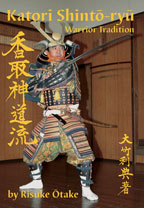
Koryu.com, one of my listed links, has just produced a new book that any serious student of Japanese martial arts should get their hands on. It is dual language, with many black and white photos throughout. While is concentrates on omote techniques, it is nevertheless a valuable resource if you're interested in gaining an insight into the thoughts and techniques of one of the greatest living swordsmen.
clipped from www.koryu.com

Katori Shinto-ryu
New from Koryu Books:
Otake Risuke's Katori Shinto-ryu: Warrior Tradition

blog it

Saturday, December 16, 2006

Sword Furnishings

It's been a long time in preparation, but finally I have another installment of images, this time of koshirae, from the Japanese Arms and Armour exhibition I attended some months ago. This chapter is longer, with more images, which are (of course) again available if anyone wants a copy--not that anyone asked last time.

Koshirae (the sword mountings with fittings that form a principal artistic part of the Japanese sword) are an art in and of themselves. They form an important part of the making of the sword, and often reflect particular virtues and interests or other symbolic meaning. To keep this entry short, I'll not delve into the thematic content of each piece or the history of koshirae in general. If you want more information on Japanese sword furniture, see Koshirae: Nihon Token Gaiso - The Mountings of Japanese Swords by C. U. Guido Schiller.

The following notes have been borrowed directly from the display text that accompanied the exhibition (except where text is in yellow). All credit for the technical notes goes to the Benalla Art Gallery and the Australian Society for the Preservation of Japanese Art Swords.

1. Tsuba (sword hand guard)

PERIOD: late Edo period (19th century)
MEI: Suruga Takaoki Inshû jû (d1856)
SUBJECT: Goose in long grass
MATERIAL: Iron

Takaoki (his personal name is Hayata Chujirô) was the son of Suruga Takashige and was ninth hereditary master of the Suruga of Inaba.


PERIOD: late Edo period (19th century)
MEI: unsigned - attributed to Ichijôsai Hirotoshi
SUBJECT: Battle of Mount Ishibashi
MATERIAL: shakudo, subject in raised iroe takazogan in shibuichi

This tsuba is unsigned but a similar signed work bearing the name of this artist is in the collection of the Museum of Decorative Arts, Copenhagen. The identification has been endorsed by the Japan Art Sword Preservation Museum.


PERIOD: Mid Edo period (ca 1700)
MEI: Signed on reverse Naoyuki (of the Hamano school)
SUBJECT: Kanzan and Jittoku with Tiger
MATERIAL: Iron

‘Kanzan and Jittoku’, a temple cleaner and poet-monk, are a popular Zen subject of Chinese origin.

2. Kozuka (a small knife with a decorative metal handle inserted in a slot in the scabbard of a sword)


PERIOD: mid Edo period (ca 1700)
MEI: Hamano Naoyuki
SUBJECT: tiger
MATERIAL: shibuichi

I am particularly taken by this kozuka. The intensity of the tiger's face is striking; in particular, the tiger's eyes are filled with a human intelligence that I find intriguing.


PERIOD: mid Edo period (ca 1740)
MEI: Tsu Jimpo
SUBJECT: A samurai mounted on a tiger chasing an ogre
MATERIAL: shakudo nanako with coloured metal overlay

Tsu Jimpo (1720-1761) belonged to the Awa branch of the Gotô school. He was a student of Naomura Masamichi and of Gotô Tsujô, the 9th master of the main Gotô line. This piece shows the official courtly Gotô style.

3. Set of Tsuba, Fuchi and Kashira

PERIOD: late Edo period (19th century)
MEI: Ishiguro Ichiju with kao
SUBJECT: crests
MATERIAL: shakudo nanako with iroe takazogan

The Ishiguro School was founded by Ishiguro Masatsune I (1760-1828). Ichiju was either a son or a pupil of Masatsune’s son Koretsune. While the Ishiguro School is characterised by its use of vibrant colours, the understated design of this set expresses the formal and subtle taste of the higher-ranking samurai.

4. Kogai (a small skewer-like utility implement inserted in the scabbard)

PERIOD: Late Momoyama/early Edo period (ca 1600)
MEI: unsigned – attributed to Ko Gotô
SUBJECT: Dragon entwined around Buddhist sword
MATERIAL: shakudo

5. Menuki (pair of carved metal ornaments under hilt binding)

PERIOD: Edo period (ca 1780)
MEI: unsigned – attributed to Mito Kuni
SUBJECT: Temple guardians (Nio)
MATERIAL: shibuichi


---------------------------------
That's all for now. I'm very pleased with the photos. I hope you're enjoying them as well, and the small amount of technical information I have on them. Keep an eye out for the final part of this exhibition, focussed on the blades and their mountings.

Wednesday, December 13, 2006

My Son's First Grading

Anna and I went to watch our son's first grading in Tae Kwon Do today. He's preempting the rest of the class, because he can't make the grading day this Saturday. We were so proud, watching him perform his kicks and punches, all with a kiai full of enthusiasm and energy. Daniel is naturally energetic, and Tae Kwon Do seems the perfect form of catharsis--I wish I'd been able to catch it on film.

It struck me while I was watching that children receive instruction and correction with a wonderful sincerity. Perhaps it's the degree of trust they place in their teachers, perhaps just their inherent nature or perhaps their innocence--whatever it is, children seem to leave the ego at home when they learn. Daniel and his training friends were completely open, like sponges soaking up plankton. My pride gets bruised on occasion when I'm training. Certainly I strive to do everything perfectly, but the more I think on it the more I wonder whether (sometimes, at least) my effort is purely egotistical. Daniel wants to learn because learning is a wonder to him. I'm sure that, sometimes, I want to learn to satisfy some inherent competitiveness in me; I want to be better than the man I'm standing next to. So, today Daniel taught me something, although completely unwittingly. Note to self: learn for the sake of learning. I suppose this is what Lao Tzu meant when he admonished us to retain the child.

Which leads me to a big thank you to Hall's Tae Kwon Do here in Melbourne. Great job.

Wednesday, November 08, 2006

What's in a name?

The Bamboo Sword: Hints of kendo, perhaps? Or a derisory reference to all those who pretend at swordsmanship? Neither, actually. It's the title of a short story by Shuhei Fujisawa, printed recently in the collection "The bamboo sword and other samurai tales" by Kodansha International. Fujisawa's story inspired, at least in part, Yoshi Yamada's The Twilight Samurai, which is well worth seeing if you haven't yet seen it. In both the story and the film, the protagonist is so impoverished that he has sold the blade of his katana, replacing it with a bamboo substitute.

'Yes, alright!' you say. 'But why have you chosen it for the title of this site?'

Well, because the idea of a bamboo sword appeals to me. In Yamada's The Twilight Samurai, Seibei is a modest character, contented not by his status as a warrior but by the joy he finds in his two daughters. The bamboo sword symbolises his dedication--a sacrifice made for the love of children--and also his humility, a virtue I respect and aspire to, even if Nietzsche did label it the refuge of the weak. In both Fujisawa's short story and Yamada's film, the bamboo sword is not the handicap one might expect: Seibei is a warrior, and a warrior is not defined by the weapon he wields, but by the mind with which he wields it. In fact, the faux sword is actually a strength, rendering Seibei's opponent Yogo reckless and falsely confident.

One night not too long past, while sharing a meal, my sensei asked me to consider a koan: what is a swordsman without a sword? I hesitated, not wanting to embarass myself. But, while the image of Seibei didn't immediately arise, I like to think he had some hand in prodding the answer from my subconscious. The Bamboo Sword is a nod, then, to Seibei; I hope it does him justice.